

American Counseling Association Code of Ethics

The American Counseling Association (ACA) understands the critical nature of a counselor’s day-to-day responsibilities. That’s why they developed the ACA Code of Ethics, updated every 10 years, as a foundational framework to govern professional counseling practices and help counselors navigate the challenging and sensitive aspects of their role.
Below is a summary of the ACA Code of Ethics (PDF, 5.7 MB), which was adopted in 2014 and remains the current active standard for counselors today. According to the ACA, a new version of the code should be adopted in September 2026.
Key Takeaways
- The ACA Code of Ethics aids professional counselors in upholding ethical standards, safeguarding client welfare, and maintaining the integrity of the occupation. The code offers counselors guidance in decision-making and acts as a basis for resolving ethical grievances.
- There are five core professional values that serve as the framework for the counseling profession, as outlined by the ACA. They emphasize human welfare, relationship integrity, and ethical practice.
- The ACA Code of Ethics is organized into nine major sections designed to ensure that counselors maintain elevated standards in their practices. Key areas of focus include confidentiality and privacy, professional responsibility, and resolving ethical issues.
What is the Purpose of the ACA Code of Ethics?
Ethics codes assist professional counselors in maintaining ethical practices, protecting client welfare, and preserving the integrity of the profession. The ACA Code of Ethics outlines moral obligations, provides decision-making guidance, and serves as a foundation for addressing ethical grievances. This helps counselors decide an appropriate plan of action for their clients and provides the ethical standards by which complaints and inquiries can be made regarding ACA members.
Five Core Professional Values
The ACA Code of Ethics outlines five core professional values that serve as the framework for the counseling profession—emphasizing human welfare, relationship integrity, and ethical practice. All licensed counselors undergo training in these values and commit to upholding them.
The five fundamental values, as emphasized in the online Master of Arts in Counseling at Northwestern University, are detailed below:
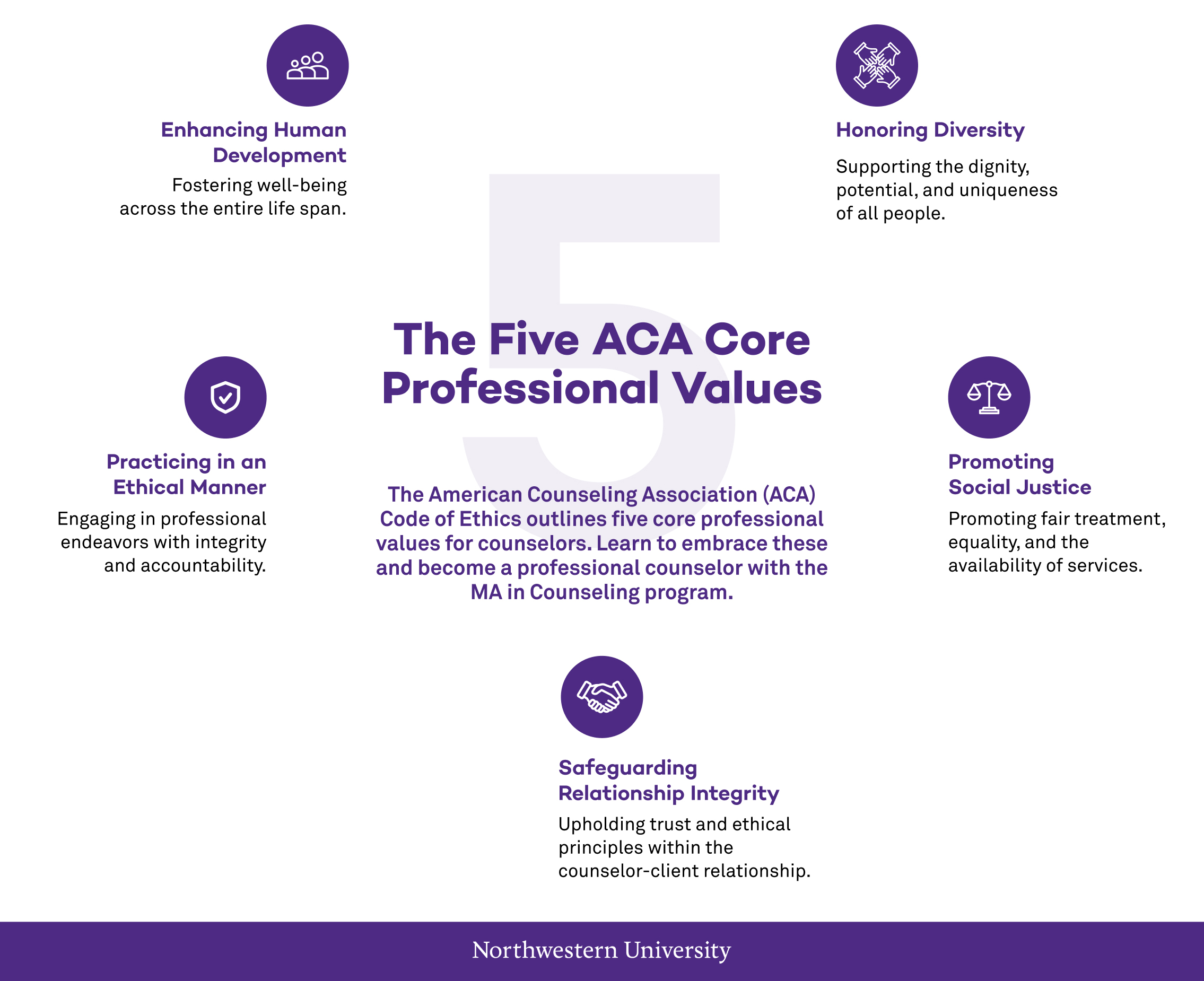
- Enhancing human development: Fostering well-being across the entire life span.
- MA in Counseling course: Human Growth and Lifespan Development
- Honoring diversity: Embracing a multicultural counseling approach to support the dignity, potential, and uniqueness of all people.
- MA in Counseling course: Multicultural Counseling
- Promoting social justice: Promoting fair treatment, equality, and the availability of services.
- MA in Counseling course: Skills for Outreach, Prevention, and Intervention
- Safeguarding relationship integrity: Upholding trust and ethical principles within the counselor-client relationship.
- MA in Counseling course: Professional Topics in Clinical Mental Health Counseling
- Practicing in an ethical manner: Engaging in professional endeavors with integrity and accountability.
- MA in Counseling course: Ethics and Legal Issues in Counseling
The infographic below illustrates the five core professional values of the ACA Code of Ethics.
What Are Common Ethical Dilemmas in Counseling?
An ethical dilemma occurs when multiple values or obligations conflict. The ACA Code of Ethics is used to navigate ethical dilemmas involving client welfare, confidentiality, dual relationships, and competency.
The following scenarios are examples of five ethical issues that can occur in counseling:
- Romantic relationships with clients: The code of ethics prohibits romantic and/or sexual interactions with clients or the family members of clients. This is a conflict of interest and violates professional lines.
- Counseling friends and family: Therapists are usually prohibited from entering a counseling relationship with friends or family members. This dynamic can impair a therapist’s objectivity and create boundary confusion.
- Connecting with clients on social media: Accepting a friend request from a client online may present an ethical issue. Building a personal relationship may make it difficult to remain neutral during counseling sessions.
- Conflicts of interest: An example of a conflict of interest would be a counselor receiving a gift from a client. This type of scenario can blur the ethical lines that distinguish therapy from friendship.
- Confidentiality vs. safety: If a client admits intent to harm themselves or someone else, the counselor is required to maintain a balance between trust and the obligation to warn or protect, which frequently entails legal mandatory reporting.
The ACA guides ethical decision-making (PDF, 924 KB) based on the principles of autonomy, nonmaleficence, beneficence, justice, and fidelity. Counselors are required to follow a carefully structured and documented process when faced with dilemmas to reach informed decisions.
Make a Meaningful Impact in the Lives of Others
How Do You Report an ACA Code of Ethics Violation?
The process of reporting suspected violations of the ACA Code of Ethics requires a detailed report, identification of the counselor, and accompanying documentation. Key steps in reporting include contacting the ACA Office of Ethics and submitting a formal complaint form. To ensure policy adherence, refer to the ACA Policies and Procedures for Processing Complaints of Ethical Violations (PDF, 318 KB).
What Are the 9 Major Sections of the ACA Code of Ethics?
The nine major sections of the ACA Code of Ethics are designed to ensure that counselors maintain elevated standards in their practices. Key areas of focus include confidentiality and privacy, professional responsibility, and resolving ethical issues. The next segment summarizes the nine sections of the code (A-I).
| Section | Focus Area | Focus |
|---|---|---|
1 | The counseling relationship | Client welfare, informed consent, and managing relationships |
2 | Confidentiality and privacy | Trust, boundaries, and managing confidential interactions |
3 | Professional responsibility | Respecting the counseling practice and upholding standards |
4 | Relationships with colleagues, employees, and employers | Developing professional working relationships |
5 | Evaluation, assessment, and interpretation | Ethical use of assessments for treatment planning |
6 | Supervision, training, and teaching | Supporting ethical boundaries in learning and supervisory environments |
7 | Research and publication | Conducting human subjects research ethically |
8 | Distance counseling, technology, and social media | Use of technology and social media platforms |
9 | Resolving ethical issues | Addressing and resolving ethical conflicts with other counselors. |
1. The Counseling Relationship (Section A)
The purpose of Section A is to provide ethical guidelines that focus on the counseling relationship, such as client welfare, informed consent, and managing multiple relationships.
Counselors must:
- Diligently strive to establish and maintain relationships with their clients founded on trust.
- Obtain informed consent from clients before entering a counseling relationship.
- Respect a client’s confidentiality and privacy.
- Explain to clients what the counseling relationship entails (e.g., fees, group work, termination).
- Be cognizant of the client’s culture, values, and beliefs.
2. Confidentiality and Privacy (Section B)
The purpose of Section B is to provide ethical guidelines that focus on the importance of trust, boundaries, and confidential interactions.
Counselors must:
- Communicate the concept of confidentiality with their clients on an ongoing basis and do so in a culturally sensitive way.
- Inform clients about the limitations of confidentiality regarding what situational information must be disclosed (e.g., to protect clients or others from harm).
- Discuss if and how information may be shared with others.
- Understand legal and ethical issues involved in working with clients who cannot provide informed consent, such as minors or clients with impairment.
- Ensure that records are maintained and stored in an approved manner.
3. Professional Responsibility (Section C)
The purpose of Section C is to provide ethical guidelines that focus on respecting the practice of counseling.
Counselors must:
- Adhere to the ACA Code of Ethics.
- Practice within one’s boundaries of competence.
- Participate in associations that help improve the profession.
- Practice counseling based on scientific foundations.
- Be mindful when advertising and talking with the media.
- Engage in self-care activities so they can work at their highest capacity.
4. Relationships with Colleagues, Employees, and Employers (Section D)
The purpose of Section D is to provide ethical guidelines that focus on developing working relationships with those within and outside of the counseling field.
Counselors must:
- Develop relationships with colleagues from other disciplines and be respectful of those who have different theoretical approaches.
- Provide consultation services within areas of competence.
- Provide appropriate consultation referrals when requested or necessary.
5. Evaluation, Assessment, and Interpretation (Section E)
The purpose of Section E is to provide ethical guidelines that focus on how to ethically use formal and informal assessments to guide treatment plans and intervention selection.
Counselors must:
- Understand the use of assessments as an important part of information gathering, and to assist in conducting clients’ treatment and evaluation.
- Utilize assessments in education, mental health, forensic fields, and career evaluations (among others) for which they have received training and had comprehensive supervised experience in administering and interpreting.
- Diagnose clients and interpret assessments accurately in a culturally sensitive manner.
6. Supervision, Training, and Teaching (Section F)
The purpose of Section F is to provide ethical guidelines that focus on how to develop relationships with supervisees, students, and trainees in ways that support ethical boundaries in a learning environment.
Counseling supervisors must:
- Acquire training in supervision methods and techniques before providing supervisory services.
- Take charge of overseeing the well-being of the supervisees’ clients as well as the performance and growth of supervisees through various supervision methods, including regular meetings and live supervision.
- Inform supervisees of their clients’ rights and inform clients of information regarding the supervision process and its limitations on confidentiality.
- Be aware of and address the role of multiculturalism and diversity within the supervisory relationship.
- Endorse supervisees that they deem qualified and sufficiently able to perform duties in the areas of certification, licensure, employment, or completion of an academic or training program.
Counselor educators must:
- Be knowledgeable regarding the ethical, legal, and everyday aspects of the profession, including how diversity impacts groups and individuals.
- Inform students of their ethical responsibilities and standards as professionals and as students.
- Provide ongoing feedback and evaluation, and act as gatekeepers to the profession.
- Promote the use of techniques, procedures, and modalities that are grounded in theory and have scientific foundations.
- Develop clear policies and provide direct assistance regarding field placement.
Counseling students must:
- Be aware of their responsibility to follow the ACA Code of Ethics and applicable laws.
- Understand the implications of taking a break from counseling others when impaired.
- Disclose their status as supervisees before they begin counseling others.
7. Research and Publication (Section G)
The purpose of Section G is to provide ethical guidelines that focus on how to ethically conduct human subjects research and publish and/or present results.
Counselors must:
- Conduct research that adheres to ethical guidelines, complies with federal and state legislation, follows institutional regulations, and meets the scientific standards governing research.
- Adhere to confidentiality in their research.
- Be responsible for participants’ welfare throughout the research process.
- Inform individuals of their rights as research participants through informed consent.
- Plan, conduct, and report research accurately.
8. Distance Counseling, Technology, and Social Media (Section H)
The purpose of Section H is to provide ethical guidelines that focus on how to ethically use technology and social media within the field of counseling.
Counselors must:
- Be knowledgeable about the laws governing distance counseling and social media.
- Only utilize distance counseling after gaining competence through training and supervised experience in this specialty area.
- Inform clients about the limits of confidentiality and potential Internet interruptions due to the nature of technology.
- Understand the benefits and drawbacks related to distance counseling.
- Employ a professional demeanor when they opt to engage with social media platforms.
- Avoid disclosing confidential information through social media.
- Utilize informed consent to explain the boundaries of social media.
9. Resolving Ethical Issues (Section I)
The purpose of Section I is to provide ethical guidelines that focus on how to address and resolve ethical issues with other counselors.
Counselors must:
- Behave in an ethical and legal manner and recognize when there is a conflict between ethics codes and laws.
- Utilize and document an ethical decision-making process when faced with a moral dilemma.
- Hold other counselors to the same standards of professional conduct.
- Address ethical dilemmas through transparent and direct communication with all parties concerned.
- Seek consultation when necessary.
- Become familiar with the ACA Policy of Procedures for Processing Complaints of Ethical Violations and use it as a reference.
Additional Information
This summary of the 2014 ACA Code of Ethics is meant to introduce and review the main points of the code. Professional counselors are responsible for reading the document in its entirety and understanding how to implement the ACA Code of Ethics into practice.
For additional information, refer to the complete ACA Code of Ethics (PDF, 5.7 MB), as approved by the ACA Governing Council. Please note that the 2014 code of ethics is still the current version actively being used by counselors today. According to the ACA, a new version should be adopted in September 2026.
Created by the online Master of Arts in Counseling program from The Family Institute at Northwestern University.